
What is Co-Active
Co-Active is a relational model for coaching, leadership, and life that integrates who you are with what you do—and elevates how you show up in the world.
The Co-Active Model, Principles, and Philosophy
A framework for how people actually change
Most coaching models focus on goals and actions. Co-Active works at a deeper level of your values, identity, purpose, and relational capacity. The Co-Active model’s core philosophy is that how people relate to each other shapes the results they create together.
That matters whether you’re a coach, a leader, or a parent.
And that leads to more ownership, more consistent follow through, and greater growth. We organize the Co-Active framework around four cornerstones. Together, they give a practical model for working with the whole person.
The Four Cornerstones of the Co-Active Model
The four cornerstones shape how every Co-Active-trained coach or leader engages with others.
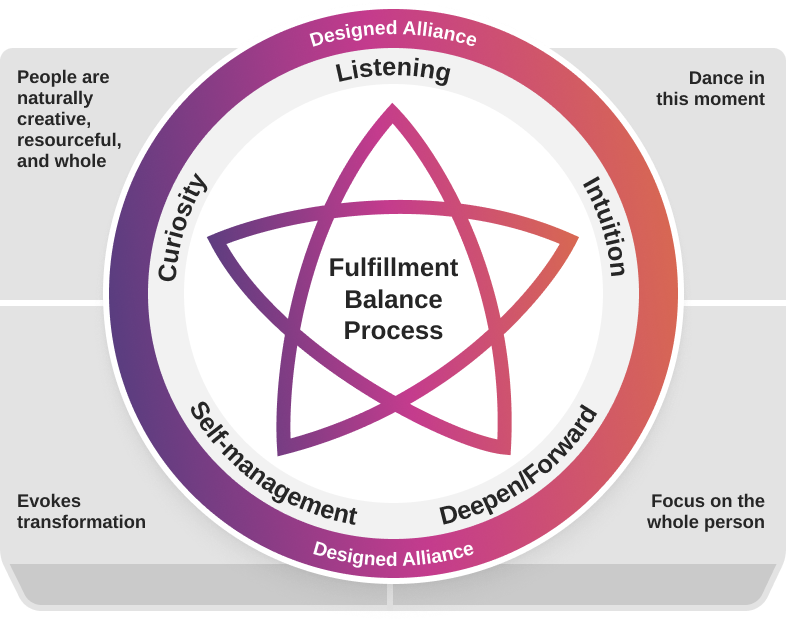
People are naturally creative, resourceful, and whole
People are not broken and do not need fixing. They have the capacity to develop, recover, and grow when held in the right kind of relationship.
Dance in this moment
Co-Active coaching follows what is actually present — what the person brings, what arises in the relationship, what matters right now — rather than a fixed agenda.
Focus on the whole person
Heart, mind, body, and spirit all come into the conversation, alongside values, roles, and lived experience. The whole person drives behavior, not just the presenting problem.
Evoke transformation
The aim is not incremental improvement alone, but a shift in how a person relates to themselves, others, and their work.
What Does Co-Active Look Like in Practice?
Where the framework produces real change
In Organizations:
In Leadership:
Co-Active practice cultivates a leader’s relational intuition to move fluidly across different contexts and situations while building teams that require less direction and take more ownership.
Learn more about Co-Active Leadership: Distributed Leadership, designed specifically for today’s leaders in any role.
In communities:
In personal growth:
Co-Active coaching meets people in the midst of major life shifts, such as transition, burnout, or questions of purpose, offering a way forward grounded in Co-Active’s principles of Fulfillment, Balance, and Process so that practical choices and deeper inner questions can be worked with together.
The Co‑Active Model

How Is Co-Active Training Different?
You learn it by living it
From the first session, participants are coaching and being coached, receiving real-time feedback from faculty and peers, and working through actual situations rather than case studies.
Every Co-active course is co-led by two master faculty members who model Co-Active partnership in real time as participants learn it.
Dr. Carlos Davidovich, MD, a neuromanagement expert and executive coach, documents how the Co-Active model activates the brain mechanisms involved in change—specifically how repeated experiential practice builds new neural pathways in ways that lecture-based learning does not.
Because Co-Active training mirrors how the brain actually forms new habits, the behavioral shifts participants develop are designed to last long after the course ends.
Co-Active Training
-
Transfers immediately
Skills learned in a Co-Active course apply the same day: in the next one-on-one, the next team meeting, the next difficult conversation.
-
Applies across contexts
The same relational skills that make a better coach make a better manager, parent, colleague, and partner.
-
Compounds growth
The more you apply Co-Active principles, the more they develop—and that development naturally spreads to the people around you.
How Co-Active Compares to Other Coaching Models
Co-Active provides context for other coaching tools
Co-Active is not a replacement for frameworks like GROW or Solution-Focused coaching. It operates at a different level. Some coaches use those structures to shape a specific session while working within a broader Co-Active context: clarifying whether a goal is values-aligned, exploring what the client’s relationship to that goal reveals, and looking at what kind of change is possible beyond behavior alone.
The table below compares how Co-Active sits alongside other common approaches across a few key dimensions.


Experience Co-Active for Yourself