
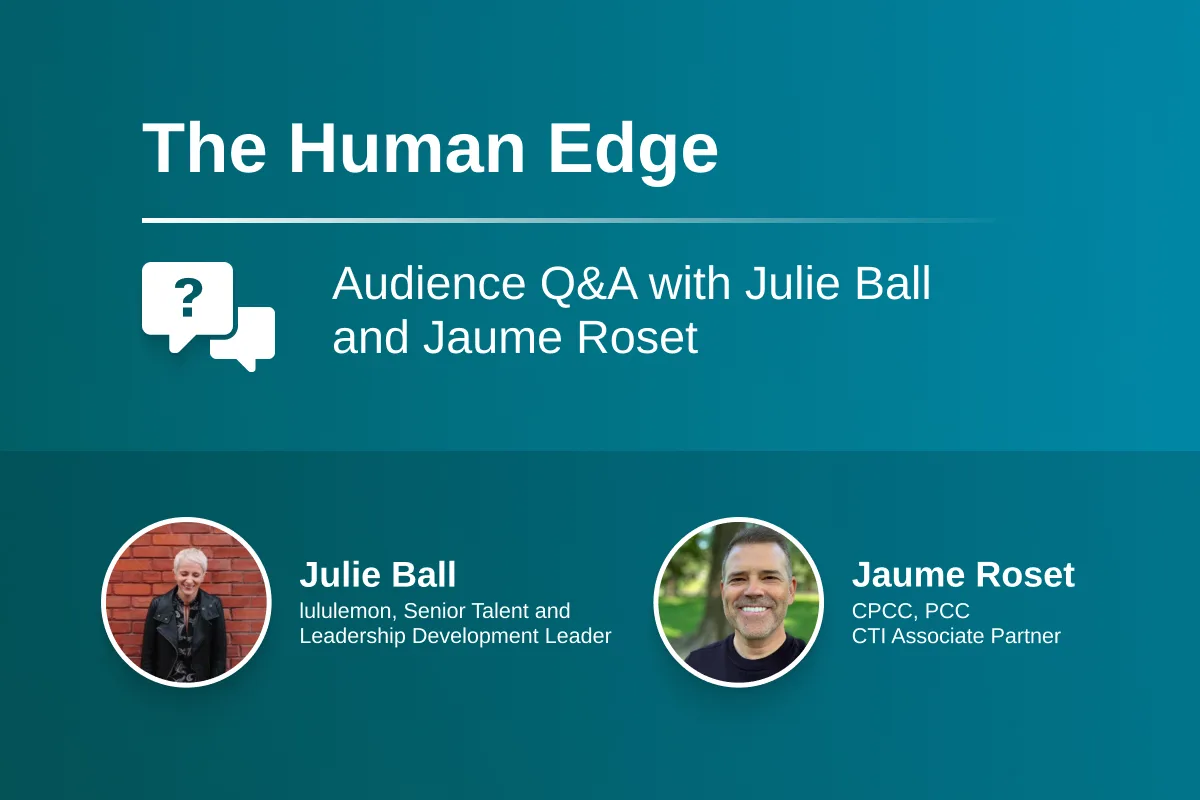
At The Human Edge: Leadership in an Age of Rapid Change, Julie Ball of lululemon and Jaume Roset, CPCC, PCC, Associate Partner at the Co-Active Training Institute, talked about leading people well while AI and constant change reshape how work gets done. Attendees brought more questions than the session had time to answer, through the live Q&A, in the chat and in the post-event survey. Julie and Jaume answered many of them in writing afterward, and their responses are below.
The questions show where leaders’ attention is right now. Several attendees described pressure to move faster and produce more as AI raises expectations, and many wanted to know how the human side of leadership holds up under that pressure. Others asked whether AI can coach, how to make the case for coaching to the people who fund it, and how to support teams through restructures. Running through all of them is a practical concern: how to keep people at the center of the work when the pace leaves little room for it.
Responses have been lightly edited for length and clarity.
AI, pace, and the need for connection
Is AI bringing grind culture back?
One attendee is seeing a return of grind culture, including 996 schedules (9 a.m. to 9 p.m., six days a week) and a “live to work” mindset. When AI promises a 10x productivity boost, 10x output becomes the expectation. This may be most visible in tech.
Julie: I’ll let Jaume speak more to the tech side, since it’s not something I’m hearing about directly. That said, retail has never stopped. Hustle and 10x output are constant, because if you take your eye off the ball for a moment, the next brand is ready to replace you. So grind culture is a real possibility, which is why a human-centered approach is so important. There’s a real risk of burnout.
Jaume: I agree with Julie. That is why it is important to find a balance between rigor and humanity. Both are necessary. It is about creating an environment of psychological safety, rooted in humanity. As I mentioned during the panel, psychological safety does not mean simply feeling comfortable. It means feeling secure enough for someone to push you out of your comfort zone so you can perform at your best. Psychological safety is a prerequisite for high performance.
Can AI coach?
One attendee argued that AI can never coach anyone, because coaching is something humans do with other humans. Another asked how to keep communicating what only people can offer as AI use speeds up. Do you agree, and how do you make that case?
Julie: I agree to a point, though I ask AI for advice regularly, ha! It doesn’t replace my mentor, therapist, or coach, and we aren’t looking to replace live coaches at lululemon. But if I’m spiraling in the moment and need quick reassurance or a thoughtful prompt, AI asks surprisingly powerful questions. I wouldn’t rule out in-the-moment AI “coaching” as a helpful supplement to real human sessions.
Jaume: AI helps with session preparation or post-session analysis. But as of now, it is not capable of feeling emotions, forming connections, or using intuition. I’m not saying it won’t ever happen, but we aren’t there yet.
Why do people feel disconnected when they have every tool to stay connected?
Julie: In a digital-first world, employees of all ages are craving in-person connection (IRL, as the kids say). Nothing replaces being with real humans and making embodied connections. At the same time, social media helps many people find their people, so it’s all about balance. Whether we’re burnt out from overcommitting socially or experiencing digital exhaustion, the first step is to pause, check in with ourselves, and ask, “Is how I’m choosing to connect with others working for me? Do I feel fulfilled?” If it isn’t, decide what to change. Maybe the connection you need more of is the one with yourself.
Jaume: Authentic connection is about the ability to be present for another person: to listen, to truly see the other, and to be seen in return. Technology does not guarantee this, which is why many people feel lonely and disconnected. For this reason, effective leaders learn these skills, many of which come from the field of coaching.
Holding the human side of leadership
What gets in the way of the human side of leadership in fast-moving, matrixed organizations?
Julie: Common roadblocks, real or perceived, are rapid change, moving too quickly, and organizational complexity. Teams get siloed, start working against each other, and fall into an “us versus them” mindset. When that happens, we have to get in a room, name it, and align on a path forward. It always comes back to our purpose, mission, values, and vision. If we’ve lost sight of who we are when we’re at our best, we need to have an honest talk with ourselves.
Jaume: In my experience, the greatest risk is a focus on short-term results. We need leaders with a long-term perspective, capable of fostering work environments where results are viewed through the lens of purpose and values over the long haul. And that is no easy task.
What do leaders need so they don’t get lost in the whirlwind?
Julie: In general, leaders need permission to cut out the noise, even if that noise is coming from me and my team! Close your eyes or look in the mirror and ask, “What is it time for now?” Follow that instinct and don’t look back. I trust the leaders in my company to lead the way.
Jaume: They need a steering committee that supports them and believes in this type of leadership. Directors and managers are the backbone of the company. They are the ones who make things happen, and they need the steering committee to believe in and support this leadership style.
How are leaders adapting to people who prefer a transactional, results-oriented environment?
Julie: We get asked this a lot, and I always think of The Culture Map, which breaks down how different cultures respond to leadership styles. For markets with a more top-down approach, we meet them where they are and listen to how it’s working for their people. If it works, great. We might just suggest adding five minutes of human connection to meetings to see how it feels. It’s important not to assume a top-down or high-direction approach is a bad thing. Ultimately, joining lululemon means leading in alignment with our values without sacrificing your own. Bottom line: there are times when people just need to be told what to do, and that’s okay too. This is retail, after all. Things move fast!
Jaume: I like the perspective Julie brings about adapting to the environment you’re in. Building on that, I’d like to talk about how culture affects who we hire. In many companies, I see an initial cultural screening when someone is being considered for a role: what are this person’s values? If they don’t align, the person isn’t hired. And while some companies are more hierarchical and transactional, research consistently shows that when people have a sense of meaning and a connection to their values, their performance improves. A 2014 study published by Harvard Business Review, “From Purpose to Impact,” by Nick Craig and colleagues, looks at how a sense of purpose and meaning in one’s work positively affects various company KPIs.
How can leaders support a team facing a restructure and job cuts?
Attendees asked how to stay present and constructive with teams facing a restructure, and how to support people whose livelihoods and career goals feel derailed.
Julie: During a restructure, I ask my team to focus on what they can control, namely supporting the end users who rely on our programs to become stronger leaders. At the same time, I hold space to acknowledge that uncertainty is stressful and hard. I commit to sharing updates the moment I get them and escalating any questions keeping them up at night to senior leadership.
Building coaching into the organization
How do you help managers coach their people instead of handing it off?
Julie: That’s a risk for sure. In our world, it’s an and, not an or. We offer 1:1 coaches to accelerate growth, and we train managers to take a coach-like approach. Coaching was our #1 requested skill in many markets this year, which shows we’re striking a healthy balance, though it’s something we always keep an eye on.
Jaume: By developing them. A good leader must have certain skills, and these skills are absolutely essential. At the Co-Active Training Institute, we teach how to develop these skills in a rigorous and consistent way.
How can leaders coach in the moment without it feeling performative?
Julie: Coaching in the moment comes down to relationship and timing. It only feels performative if there’s no trust that you have the person’s best interests at heart. Timing matters just as much, since unsolicited coaching at the wrong moment feels condescending. Always ask permission first: “I’d like to learn more about something I observed today. Is now a good time?” Dropping the word “coaching” altogether often puts people at ease. At its core, it’s just asking questions to seek understanding. A confident leader might say, “I’ve been working on my coaching skills and want to ask you a few questions to support you. Would that be okay?” Then ask at the end how it felt to be asked questions instead of being told what to do.
How can leaders who put short-term results before people be nudged toward sustainable results?
Julie: I can’t, and won’t, try to convince a results-only leader to change. Is it working for them and the team? Is that what it’s time for, or what the job entails? I’d have to understand all of that before judging their style to be wrong. Instead, I lean into the data. I show them their team’s engagement, happiness, and overall sentiment compared to our core values and Leadership Practices. A lack of “humanness” will always show up in a team’s Pulse metrics. From there, it’s up to that leader’s manager to hold them accountable for building sustainable, engaged teams, not just hitting numbers.
Jaume: I have seen two approaches work. The first is presenting facts and figures that show the impact of these human skills in terms of tangible results. The second is running pilot projects that need only a small investment, so the results can be seen right away.
Who goes first in a coaching pilot?
Building on the advice to start with a pilot, one attendee suggested asking who would actually be open to being coached.
Julie: I usually start with my own People & Culture team, since they’re knowledgeable and open, know the business really well, and can anticipate how something might land. Then I move to a more complex function that still has high engagement. Because we use coaching to retain high performers, not fix underperformance, people are already eager to grow. When we first piloted coaching inside a high-potential program, it scored a 100% satisfaction rate. We isolated it and expanded it yearly, so it became something the business pulled from us, instead of something we pushed onto people. A lot of people love being included when they know they’re helping build the future.
How can you shift the thinking of nonprofit CEOs who resist KPIs?
Julie: Ha, this is actually how lululemon felt about people development back in the day! We didn’t have graphs or charts. We just knew it felt good and drove sales, and our growth proved it. For these CEOs, I’d start by asking how they want to get feedback. Everyone wants to know if their programs are landing, and lululemon is relentless about feedback so we can stay in the real conversation. I might open with, “I know we don’t want to over-measure or focus too much on KPIs, but I’m curious about X. How about you?” It’s a simple pulse check to see if your impact matches your intent.
Jaume: Indicators and results are key. Let me offer a metaphor: you cannot live without breathing. Results are like oxygen, and a company that fails to deliver results will cease to exist. Yet no one lives merely to breathe. At the same time, pursuing a purpose or upholding values inside a company that lacks results leads the project to a dead end. Both are critically important.
How do you measure coaching’s impact and make the business case for it?
This was the most common theme in the post-event survey. Attendees asked how to tie KPIs to coaching, what data shows its impact, and which arguments convince companies to invest.
Julie: We’ve decided not to tie coaching directly to revenue or sales. Instead, we use self-evaluations to measure whether coaching retains talent, enhances performance, and accelerates goal progress. For executives, we include their manager to co-design development goals and assess progress at the end. These metrics resonate well with our senior leaders, most of whom already value coaching in their own careers.
Resources from the panel
- Gallup: Employee Engagement Below 30%
- The Leadership Circle and Organizational Performance (public summary)
- Why Human-Centered Leadership Matters Right Now, Teresa Hopke, Forbes, May 2026
- From Purpose to Impact, Nick Craig and Scott Snook, Harvard Business Review, 2014
- The Culture Map, Erin Meyer
Follow the panelists
Both panelists say LinkedIn is the best place to follow their work.
Bring these skills to your leaders
Julie and Jaume have both seen coaching skills change how leaders and teams work. Co-Active Coaching for Business helps leaders build those skills and bring them into their everyday work with their teams.