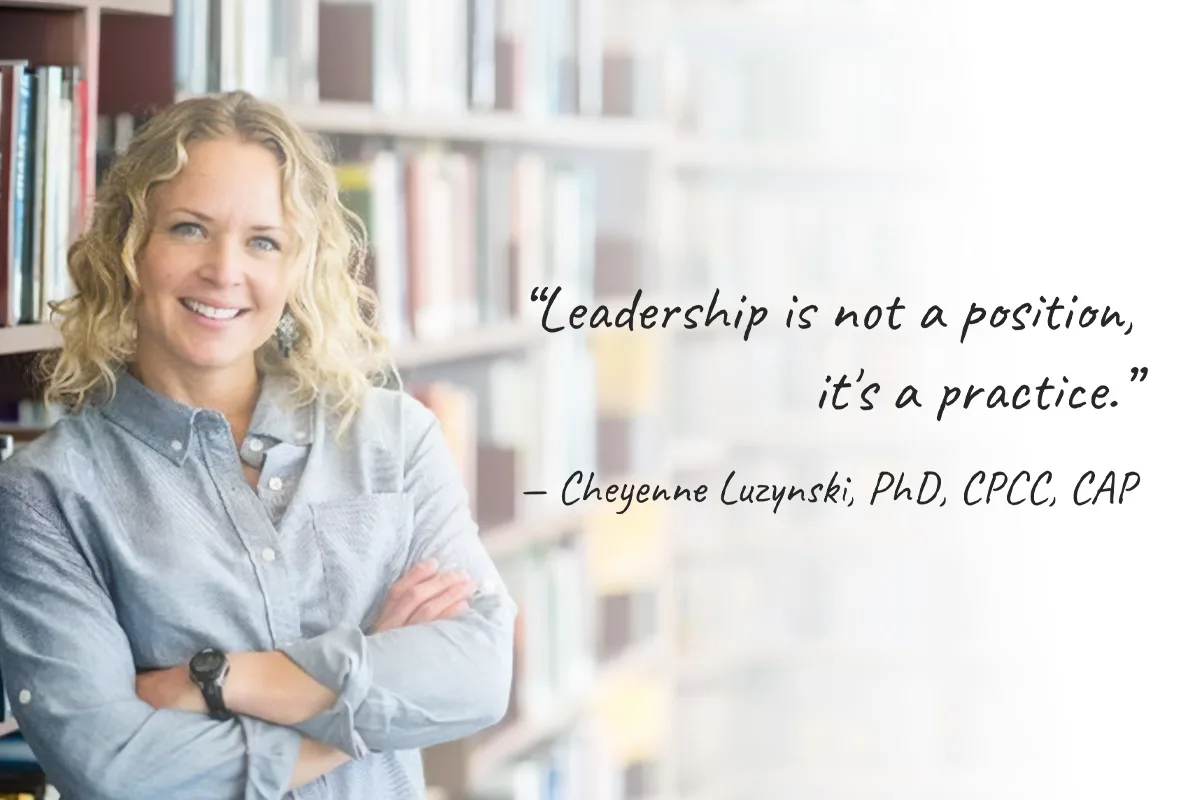
Cheyenne Luzynski, CPCC, CAP, has spent roughly 25 years in the leadership world, and she has a short answer for why it holds her attention: because leadership matters. She is a professor of leadership studies at West Virginia University, now in her 11th year there. She teaches in an interdisciplinary leadership minor that draws students from across the campus, including engineering, pre-med, PR, business, and journalism.
Her path to the classroom ran through college athletics. She was a head volleyball coach and assistant athletic director, and at one point she was the only woman working across 30 varsity sports. That experience raised a question about representation that sent her back for a PhD in educational leadership. While completing her doctorate, she created an interdisciplinary leadership minor. Since then she has approached leadership as something that can be learned, that should be available to everyone, and that unlocks potential.
Coaching came later, by way of a friend. A former college volleyball teammate, Rachael “Roach” Finley, who was training as a coach offered her six sessions, and by the end of them Cheyenne knew she wanted to do this work herself. She began Co-Active training in August 2023 as part of one of the last legacy cohorts, completed her coach certification in April 2026, and then joined a pilot group testing Co-Active’s new offerings, including Distributed Leadership.
That combination is what makes her perspective unusual: she is a leadership scholar, a certified coach, and a teacher who spends every semester with the people about to enter the workforce. Cheyenne explains why Distributed Leadership felt new to her as someone who lives in this field, what she’s seeing in the next generation of leaders, and why she believes coaching is the future of education.
You have a one-line answer for why leadership matters to you. What’s behind it?
My short answer is because leadership matters. It is the language that helps communicate across disciplines. It is the way in which we advance society. It is how we wrestle with wicked problems. To me, it’s such an important way of building our future. And I also know it’s the most observed but least understood phenomenon that exists within our existence. It’s really easy to point out, oh, that’s good leadership or that’s bad leadership. But to actually understand the phenomenon is really hard. It’s abstract, there’s so much nuance, and I’m really comfortable with that level of ambiguity.
Another personal philosophy is that leadership is a choice. If we’re conscious about our choices, what informs them, what motivates them, the values behind them, and we act on that alignment, then we can act in leadership.
You’d coached athletes and mentored students for years. What made coaching feel different when you were the one being coached?
I came to it in a roundabout way. A dear friend of mine was going through Co-Active and looking for clients to get her hours, so I signed up. I immediately thought, wow, I’ve never been coached. I’ve obviously coached athletics and mentored a ton of students, but this was different. By the end of our six sessions, I was like, I think I want to do this. This is taking what I do to the next level. It was also more effective in creating life changes than any of my therapy sessions at the time.
You’ve been through a lot of leadership programming. For someone who lives in this field, what made Distributed Leadership stand out?
I’ve gone through so much Co-Active programming in a concentrated time, and the distributed leadership experience was by far one of the greatest. I live in this world, and I was blown away by the messages, the learning, and how it was orchestrated.
I never profess to be an expert in leadership, because how can anybody really be an expert on something that is socially constructed and slippery and context dependent? I go into it with a solid understanding of foundations, theories, and principles, and this experience transcended that. I want to give credit to the facilitators, Jeff Jacobson and Edwin Vega. They are masterful. They’re well trained in the Co-Active pedigree and philosophy, and it showed up.
You’ve said the content wasn’t what surprised you most. What was?
The pace. The emphasis wasn’t on the content. The emphasis was always on what was happening in between. It wasn’t about learning a structure, practicing it, and reflecting on frameworks. Certainly there was that, but it was secondary to being fully present and building authentic connections with each other and with the moment. And it was only a product of everybody contributing.
I say this to my class too: Aristotle said that morality is defined by the minutiae. If you can just be open to the most micro moments, they have such big impact. What we experienced was really that. I got to be a witness to it. I got to participate in it. I got to feel it and sense it and learn how to navigate that.
How did the design of the course reflect what it was teaching?
At a basic level, leadership is a process. Leaders are people who do things and make decisions. We often conflate leadership with leaders. When we think of leadership, we name traits of a person. We don’t name the aspects of a process, like clear communication or transparency. What they did was create a process that represented and reflected leadership intentionally, and then facilitate all of those moments of understanding the process as leadership.
I was also really impressed that we set up promises, assumptions, and agreements. As an educator, I live in the world of learning objectives and wanting to create a culture in the classroom, with safe and courageous spaces. This was it. It wasn’t sound bites. It wasn’t buzzwords. It was real effort, honest and humble.
The program’s workbook opens with the idea that leadership is already in you. Why did that land?
The idea is that leadership is not a position, it’s a practice. It’s not top down, it emerges from everywhere at once, and it’s more sustainable. The other thing I underlined is that leadership is already in you: in how you listen, how you respond, how you show up in a room, on a team, in a community. The course helps you see that more clearly, act on it more deliberately, and recognize it in the people around you.
I thought, what a succinct way of presenting the stakes of this experience. It’s something I’ve tried to cultivate as an educator, but to see it stated that way, I was like, okay, I’m ready. I’m in. I also recognize a lot of people would read it and think, that’s not me, I’m really uncomfortable. Which is another invitation to explore.
You’ve talked about the Western discomfort with paradox. Where does Distributed Leadership meet that?
There’s a cultural preference in the West for immediacy: solve the problem, get through it, without really being able to step back and absorb. Simon Western writes about eco-leadership, and he does a great job talking about paradox. Leadership is a paradox. All of life is a paradox. We’re constantly in contradiction, and the Western (not to be mistaken with the author) perspective is really uncomfortable with that. Push through, figure it out, get an answer. So the question becomes, how comfortable are you with sitting in contradiction?
Distributed leadership has this model where you stay. You sit with the paradox or the discomfort and learn about it, rather than following the habit to get out of it. You stay with it until the urge strikes to do something, and the urge is intentional, not from a place of reactive. It’s not an escape because you’re feeling uncomfortable. Or you pass the practice to somebody else who still has that staying power.
What’s your single biggest takeaway?
Leadership exists in every moment. Leadership oftentimes defaults to positions and the titles we step into, even when they’re temporary or fluid. But break those walls down and really say leadership exists in every moment, and give everyone permission to engage, offer up, share, and step back in every moment. That’s the practice of leadership. How amazing would that be for society? It’s permission-giving to everybody. Leadership doesn’t exist only within a captaincy or a title, but in the hands of everyone. That is truly distributive
That’s the thing that really got me. I spent time thinking about it and then asked, how can I teach leadership with that mentality? Stop getting in your own way. We’re putting up walls and barriers and abiding by rules that are often made up and serving someone else’s interests. They’re actually doing more harm than good.
How has it changed the way you teach?
It has shifted how I talk about leadership in class. Students expect to be in a leadership class to increase their skills and become better leaders, and certainly there’s some of that. But who you are is how you lead, so I really try to invest in who students are and get them more connected to themselves. There are so many young people who are lost, who’ve never had the opportunity to figure out who they are, because their entire lives have been catalogued visually. There’s this awareness of the panopticon, of being under a scope and observed all the time as a young person, and it shapes and interferes with their ability to understand who they are.
This experience has encouraged me and given me confidence to dive into that. It’s why I like teaching leadership. It matters more for these generations, who have continuously been disappointed by the traditional modes of leadership.
You recently asked your students to imagine leadership 30 years from now. What did they see?
We’d been moving through leadership theory over time: great man theory, traits, behavioral, situational, contingency. These are more industrial constructs, where the power is typically top down. So I said, let’s dream what leadership looks like in 30 years. Before we got into it, I took a poll, and about 65% raised their hands to say they’d responded with a more negative perspective.
Some of what they came up with was the influence of AI, automation, robots, and colonizing Mars. But they also understand that the pendulum is swinging. They can’t place where it’s at, but they know there’s going to be a swing in the opposite direction. Their responses included: I’m not going to want my kids on screens. We’re going to be outside. This call to rewild. The investment in education. And I heard one profound response, who controls the data, because whoever has information and controls it is really going to have power.
You encourage students to take agency over their lives. Is that getting harder?
I use the metaphor of the conveyor belt of life. You just move through time and space, but you’re not really aware of what’s going on. It resonates with college students because it’s like, I was just a freshman, how am I already a senior? Who am I? What have I actually learned? My encouragement is always to have intention and to choose to step off the conveyor belt. That takes a lot of courage, because it could mean stepping away from your parents’ expectations or choosing a different lifestyle.
But I’m finding it is so much harder for them to step off. I’ve had students ask, is there an off-ramp to this now? Are we too deep? That’s reflective of how pessimistic this generation is, and I’m giving some large generalizations here. They’re bombarded with pessimism, and they haven’t been taught how to lift up others, to encourage others, to champion one another, to feel hopeful, which are very much themes in Co-Active.
Beneath the pessimism, what do you see?
A lot of opportunity. I think this is the paradox: they project pessimism, but inside, they deeply want to be loved. When I give students one-on-one time, like the one-on-one coaching I’m doing with a small group, they’re like, oh my gosh, just to be heard, to be seen, to communicate some of these inner workings. They don’t have an opportunity to do that, because their friendships aren’t even at that level. Where we would have turned to a friend and said, hey, I need to have a heart-to-heart, that doesn’t feel safe.
There’s this deep desire to know that they matter and that they are loved, and I hope that’s part of the pendulum swing. Maybe we can offload all of these things and automate some of them, but then what? Then the focus needs to be on human connection. Our reaction to the sophistication is a return to the most simple.
Where does the Co-Active model fit into that picture?
The Co-Active model is unique and, I feel, very timeless, because it gets at the nature of human being and doing: our need to be witnessed, to tell stories, to think about the narratives that drive us, to express, to move, to physically embody, to pay attention to what feeling is and where it exists. It’s given me a playbook and permission to tap into those unique human qualities, and also the courage to go there. Fierce courage is a term in the Co-Active model.
There’s so much suffering and healing needed in this world, and I find that Co-Active offers a path to heal for a lot of people. The healing is just basic presence: sitting with somebody, listening, helping them figure out things they’re working through. It doesn’t offer a psychological model, and a lot of people do need that kind of healing too. But it really is about human love and connection, and how to help each other heal.
What would you say to the leaders who will be hiring your students?
The thing that comes to me is doing the inner work: connecting to themselves, challenging assumptions, doing the reflection, and learning how to facilitate that with others. Positional authority and titles still exist, but how leaders talk about them is going to matter. Those assumptions about authority do not hold up with this younger generation. You can’t have an assumed level of respect because of the position, which is what distributed leadership tries to break down. Gen Z prefers flatter organizations. The idea of hierarchy and authority is like, whatever. Why would they trust that? They’ve seen it abused over and over.
This younger generation is paralyzed with fear: fear of getting it wrong, being criticized, being judged. So teaching them about these roles of leadership, recognizing the urges, and recognizing when they’re self-sabotaging because of doubt is important. That’s why the coaching aspect, the one-on-one support, is going to be so important.
You’ve said coaching is the future of education. What does that look like?
I still believe coaching is the future of education, and hopefully part of our workforce, because we can’t just assume people are doing this inner work on their own time. We need to engineer the spaces and opportunities for the work to get done. It takes time, and it’s an investment, but it matters for the sustainability of whatever organization it is, and of the communities people share space with.
I like the idea of coaching as a philosophy applied to how work exists, occurs, and is expressed. I won’t offer it as a panacea, but coaching allows for the development of self-expression, confidence, clarity, and direction: the inner knowing, the connecting to values and purpose. That support helps facilitate greater team creativity. It’s not as visible in the education space yet. But with AI completely hijacking education, if institutions want to find relevance, I’m trying to position myself where coaching is the inoculation that education needs.
Experience distributed leadership for yourself
Cheyenne’s story shows what happens when leadership is treated as a practice rather than a position, one that lives in every moment, every conversation, and every person in the room. Distributed Leadership is built for leaders who want to lead that way and help the people around them do the same.