
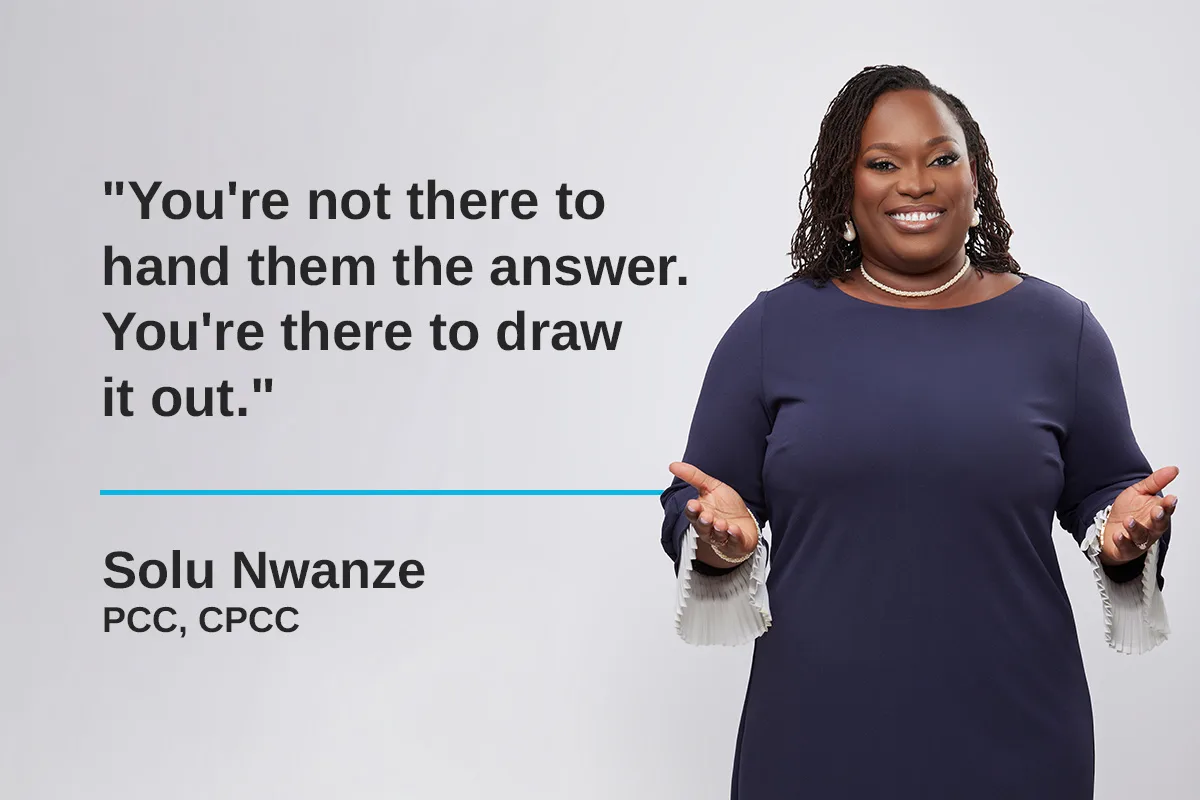
Solu Nwanze, PCC, CPCC, describes her work with a phrase she returns to often: activating leaders and architecting systems that move organizations forward. It fits. Across a career that has moved from software development to business intelligence to business operations, the through line has been design, whether she was designing products, building processes, or shaping how leaders grow.
Today she holds a dual role. In her full-time work at Reltio, an SAP company, she leads the office of the CEO across strategy, operations, and transformation. She most recently led the enterprise AI transformation, helping every functional area bring AI into daily business processes, and she is currently guiding the post-merger integration into SAP. Alongside that, she runs her own practice, Teams Who Win, an organizational performance company, where she works with executives, their teams, and their chief-of-staff functions to build the skills, tools, and systems that create real organizational wins.
Her path into Co-Active started, as these stories often do, from a few directions at once. A love of professional development. A transformative 15-minute coaching session at a women’s conference. A mentor who happened to be a certified coach and pointed her toward a Co-Active Foundations course offered at Adobe. In her first session, sitting in the semicircle and watching a live coaching conversation unfold, something clicked. She signed up for the next course, and the next, carrying the work forward even as she changed companies and climbed into higher leadership roles.
What makes her story useful for business operations professionals and people leaders is how directly the skills translated. Not into a separate coaching practice she had to carve out time for, but into the meetings she was already running, the conversations she was already navigating, and the teams she was already leading. In the Q&A that follows, Solu talks about the coaching mindset she now brings intentionally into high-stakes rooms, and about transformational coaching as she has both received it and practiced it, from diffusing tension between senior leaders to helping a client move off a performance improvement plan and into leading a multimillion-dollar project.
You’ve spent your career in engineering, business intelligence, and business operations. Where did coaching first intersect with that path?
It came from a few directions at once. I’ve loved professional development since high school, so I was always in programs that pushed growth for me and for others. At a women’s conference, there was a section where ICF-certified coaches offered complimentary 15-minute coaching sessions. I sat down for one, and I still remember it. Fifteen minutes, and it was transformative. My reaction was, everyone needs access to this.
Around the same time, a mentor of mine, who happened to be a certified coach, told me Adobe was offering the first Co-Active course for free. I signed up. It turned out to be the last offering there in that period, and I’m glad I caught it. In that first session, they ran a coaching demonstration with a real scenario, a real colleague, and the person went to tears. You could feel the transformation happening in the room. I didn’t yet know how I’d use it, but I knew it was powerful. So I signed up for the next course, and the next.
A lot of people associate coaching with starting a coaching practice. You stayed in high-stakes operational roles. How did the training actually show up in that environment?
It was immediately applicable, without any translation step. I think that’s because it’s about people, and every one of those rooms is full of people.
The clearest example: I was on the BizOps team for Creative Cloud, running a weekly three-hour business meeting with VPs and GMs in the room. I was several levels down from them, a senior manager at the time. In one meeting, two very senior leaders were going back and forth and concluded they were aligned. I said, actually, I don’t think you’re saying the same thing. I think you’re saying two different things. You could hear the room react. Afterward, the leader running that organization turned to me and said, I want you to do that every time.
The reason I could catch it is that I was listening differently. I wasn’t the subject-matter expert in that room. But the discovery skills, the curiosity, the ability to ask the question no one else is asking let me get at something the experts hadn’t surfaced. It’s a kind of authority that doesn’t come from having the most impressive title or subject-matter expertise. It comes from how you navigate the conversation.
How do you describe the coaching mindset to a leader who’s never heard the term?
I’d say the coaching mindset is a way of entering a conversation believing the other person is capable and has more in them than they’re currently showing. You’re not there to hand them the answer. You’re there to draw it out. For an operations leader, that reframe is significant, because so much of our default is to diagnose and solve. The coaching mindset asks you to slow down for one moment and get curious first. In a room full of smart people, that one move often surfaces the thing everyone was circling but no one had named.
That connects to something you kept returning to: curiosity. Did Co-Active give you curiosity, or did it give you something to do with the curiosity you already had?
More the second. Learning has always driven me, but I wouldn’t have connected curiosity to learning the way I do now. What Co-Active gave me was structure for it. Deep listening was a new context for me, and it was powerful because it’s about how you listen, and from which perspective. Listening and curiosity go hand in hand.
There’s also a systems view in the work that maps directly onto how I solve problems. Listening isn’t only to the person in front of you, it’s to the whole system in the room. That isn’t how most of us are trained to listen as professionals, and it turns out to be very applicable at work.
You’ve said you bring the coaching mindset into rooms intentionally. What does that look like in practice?
When I know I’m walking into a contentious conversation, I tell myself the coach has to show up here. I bring that energy on purpose, because that mindset is what tees out what’s really going on.
Here’s a real one. As a chief-of-staff-type leader, I was once handed a conversation with a peer who was actually senior to me in the org hierarchy. A chief officer had told this person to bring their plans to me for approval, which is an awkward setup, and the person was frustrated and upset. The only way through was coaching skills. You acknowledge what’s hard in the situation. You articulate what’s actually going on. Naming what’s happening cuts through tension like a knife. Once people feel seen, that’s half the battle, and then you can get to the content.
That’s the coaching mindset for a leader: not running a formal coaching session, but bringing that approach into the moment you’re already in.
For an operations leader who’s outcomes-driven and moves fast, where’s the payoff? What would be different without these skills?
Speed to the real issue. Plenty of capable people will eventually get to the crux of a problem. The coaching skills, the discovery, and the curiosity let you get there faster, without wasting time circling it.
The other payoff is self-awareness. Most leadership assessments split into two halves, task and outcomes on one side, people and relationships on the other. Before this training, I leaned hard into tasks and outcomes without even being aware I was doing it. That would have felt like constant pressure to my team. My team actually gave me feedback on how my style shifted once I became aware of it and more willing to move toward the middle. That awareness of self was probably the single biggest thing I gained, because you can’t adjust what you can’t see.
Imagine a peer who’s skeptical. They hear “coaching” and picture something slow and therapeutic that will bottleneck how fast they move. How do you engage that?
First, they have to experience it. Experiencing coaching yourself is what dissolves the skepticism.
I’ll give you a case. I had a coaching client, matched through a platform rather than someone who chose me, so there was skepticism from the start. A numbers person, logical, unsure why they were even there. But they kept showing up, which told me they wanted something different. That leader went from being on a performance improvement plan to exiting it and then leading a large project that brought in millions for the organization.
And I want to be clear about what did that. I did no work on their technical or business skills. None. It was about how they saw themselves. We worked on limiting beliefs, whether they were operating from scarcity or from a more expansive place. In Co-Active there’s a way of asking, where are you looking at this from, and what does the same situation look like from somewhere else? That shift is what moved them.
You’ve now experienced transformational coaching from both sides, as the client and as the coach. Does it feel different depending on which chair you’re in?
The mechanics are the same, but what you notice changes. As the client, transformational coaching felt like someone helping me see a situation I thought I understood from an angle I’d never considered. As the coach, I’m watching for the moment that shift becomes available to the person, and holding the space steady enough that they can step into it. It comes from a new relationship to what they already know. That’s the part that surprised me most when I moved into the coach’s chair. I did no work on anyone’s technical ability. The work was always about how they were meeting their own situation.
So the transformational part wasn’t a set of expensive frameworks or tools.
Right, it was coaching skills, paired with frameworks that carry meaning rather than frameworks for their own sake. Transformational coaching, doesn’t come from training someone on new technical ability. It comes from shifting how they meet their own situation. When you bring awareness of emotion and perspective into a conversation, you can watch fear dissipate in real time. I’ve seen team members and leaders name it as it happens. And it’s portable. The person who experiences it carries it into their own rooms, and it keeps spreading.
For a people leader building a team, what changes when the coaching mindset becomes part of how you lead day to day?
The team feels it before they can name it. When I shifted from leading almost entirely through tasks and outcomes toward bringing more of the coaching mindset in, my team told me the difference directly. I’d hold informal sessions to share the tools I was learning, because for me connecting happens through learning and sharing. People started saying they missed those sessions when they didn’t happen. One leader I worked with, someone well into her career and running a large team, told me she’d learned more in a year and a half than in the previous ten, and it came down to the questions. She started asking her own team, what would Solu do. The mindset is generative that way. Once a leader has it, it spreads into every room they walk into.
You also teach these skills to leaders directly. What’s the entry point you give them?
Coaching moments. You don’t have to run a full session. Listening is the key skill, and it goes hand in hand with curiosity. Powerful questions is another way to easily access coaching. Asking a reflective inquiry or powerful question allows the room clarify and align faster… something along those lines
Picture a meeting where the goal isn’t clear, one person’s on topic A, another’s on B, someone else is on C. You ask the one question that clarifies what the room is actually trying to do, and everyone thanks you, because now nobody’s losing thirty minutes figuring out the point. When leaders start using those moments, it compounds.
Bring the coaching mindset into your own leadership
Solu’s story shows what coaching skills look like inside real operational roles, in the meetings you’re already running and the teams you’re already leading. Coaching Skills for Business Leaders is built for exactly that: managers, internal coaches, HR and talent leaders, and individual contributors who want to relate to and develop the people around them.
Enrollment is open now. Reserve your spot and start bringing the coaching mindset into the rooms you’re already in.