
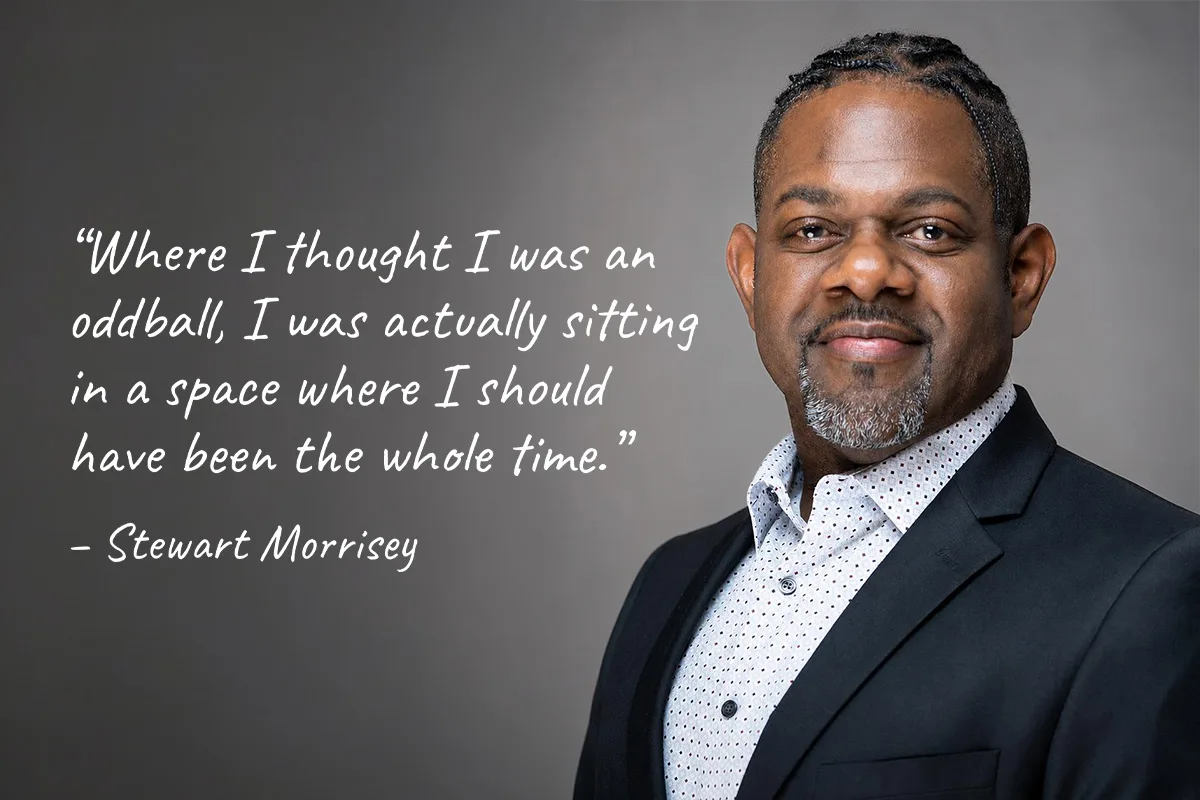
The Co-Active Model gave Stewart Morrisey the language for a coaching mindset he had been leading with for years without a name for it. A supply chain leader with more than two decades in corporate operations, Stewart came to the Co-Active Training Institute to build a coaching practice on a credible foundation. What he found validated how he already led and equipped him with a repeatable approach to transformational coaching, reshaping the way he leads inside one of the largest consumer products companies in the world.
By any external measure, his career has been a success. Yet for years he carried a dissonance: a passion for developing people that never quite squared with the feedback he received from other leaders, and a sense that his approach was working even when he lacked the words to explain why.
In this conversation, he reflects on what brought him to Co-Active, why the model resonated so immediately, and how the training changed how he shows up at work and beyond.
How does the Co-Active Model equip a leader to lead as a coach?
- The Co-Active Model gives leaders a shared language and a coaching mindset for how they develop people, validating instincts many already lead with.
- For Stewart Morrisey, Co-Active training turned intuition into a repeatable transformational coaching practice he now uses across a supply chain leadership role and a growing coaching business.
- Read on for Stewart’s account of how he found Co-Active, why he pursued it, and how it changed the way he leads.
What Was Happening Before Co-Active Came Into the Picture?
It was a confluence of a few things. Years ago, I was at a career stall, and a leader I worked for told me I needed a career coach. He hired one for me, and that completely opened up my eyes and shifted my trajectory. That was about twenty years ago, and I’m still in touch with her.
Throughout my career since then, I kept finding myself drawn to people. I’d lead recruiting programs, lead mentoring programs, or just encourage people to spend time with me so I could support their development. And people kept telling me the same thing: they’d had managers and mentors who gave them good advice, but no one who influenced them personally the way I did.
At the same time, I was watching business change significantly. Industry is shifting how it operates under economic pressures. You’re seeing layoffs, the adoption of AI, people being remote after covid. You start to lose the connection and the humanity of it all. But people still make up business. People still make a company. I kept thinking, maybe this is a way I can help reset how we think about human capital in industry.
Was There a Specific Moment When You Decided to Act?
It was exactly a year ago, August of last year. I realized I needed to do something different. That didn’t mean I wanted to quit my job or change my profession. I needed to find something bigger. I’d tried the non-profit space, but it wasn’t satisfying that for me. If I’m doing something, I have to be making an impact.
I was having a conversation with friends, and my husband had been telling me for a while that I should start my own business. After that conversation, I finally thought he was right. That was the moment.
How Did Being an Engineer Shape the Way You Started?
Everything has to be organized in a box, and my favorite thing to do is research and explore. So I started working through how you actually start and grow a business. I could have done it organically, but I had a lot of questions, and my inner saboteur was telling me no one would take me seriously without a certification.
My research suggested certification would help the business grow faster than going organically. That led me into researching how to get certified, and it narrowed down to three companies, with Co-Active being one of them.
How Did You Know Co-Active Was the Training to Pursue?
I set up interviews with all three, and just from the conversation and connection in those interviews, Co-Active stood out hands above the others. And it’s interesting, because it wasn’t based on the financial aspect. I thought it would be. I figured I’d just go for the one that was quick, cheap, and fast.
It was the advisor. The way she walked through the conversation, no pressure. She was coaching me through the process, and at the end of it, I realized she was using coaching tactics. I felt connected. I felt heard. I felt like this was a place where I was supposed to be in that moment. Once I stepped in, I never second-guessed it.
It was evident that this wasn’t just a brand. It wasn’t a check-the-box. It was a community.
How Did That Sense of Community Show Up After You Enrolled?
Two examples come to mind. After I’d registered and started Foundations, I reached back out to Kat, the advisor I worked with, with a couple of questions. She said it would be better if we just had a conversation. I figured I needed fifteen minutes, but she handled it in ten, and by the end I realized I already had the answers. I told her I appreciated her, and I was also a little frustrated, because now that I knew the language, I could see she was coaching me right then.
The second was at work. I went through an executive training program, and one of the facilitators had something about her that went beyond facilitation. I asked her where she’d learned to do what she did, and she told me she’d gone through CTI. You could feel the difference in how she led compared to the other facilitator. It wasn’t gender, it was approach. And she told me that once I was ready, I should reach out, because she’d connect me to people she didn’t have capacity for. She’d only known me as a student for six or seven months, and she was already welcoming me in.
What Kept You Moving Through the Pathway From Foundations Into Deepen?
Foundations, I remember doing the math and thinking, how am I going to get through a full work week and then sit through more training with people I don’t know. But by the end of the session I was emotionally torn about saying goodbye to those people. It was the richness of the human exploration. You’re learning the model and the language, but you’re practicing coaching in three- and ten-minute blips, watching the process work in real time with people you just met, using tools you just learned that already make sense.
Then Ignite goes deeper into the same model, because there’s only one model, so you just go further into it. And even though the sessions were long, the amount of self-investment at the end was something I didn’t expect. I learned more about myself. I felt more connected to myself.
Part of what kept me going is honestly that I’m stubborn and competitive, all of it internal. I knew I could work toward my ACC by completing Deepen. But the bigger reason is I wanted more. In Deepen, there’s real practice in a safe space. I can ask a closed question, I can forget to focus on the person and jump to the solution, and then get kindly reminded that I’m thinking about the solution and not the person. That way I’m not doing that with actual clients. I’m helping them find their own steps instead of telling them where to go.
How Has the Co-Active Model Changed the Way You Lead?
A lot of people hear “supply chain leader” and “coaching” as apples and oranges. But for years, throughout my career, I was given the same feedback: I wasn’t directive enough. That I let people experience things, let them fail, guided them instead of telling them what to do. And that never made sense to me. I’ve had a very successful career building teams that have full autonomy, which links to people being naturally creative, resourceful, and whole. I just didn’t have the language to explain what I was doing or why.
Now, when leaders around me say our teams just aren’t cutting it, I can use the model to challenge that mindset and ask why we think that’s the case. We don’t have dumb people. We don’t have lazy people. Yes, we have business problems that need to be solved, but nobody walks in and says they love sitting in all that stress. My leadership will ask why I’m so calm, and it’s because I believe in the power of the people around us and that we’ll resolve it.
I’m still new to the model, but I’ve already watched us get through moments differently than I would have if I’d just followed the typical expectations of a consumer products company. Where I thought I was an oddball, I was actually sitting in a space where I should have been the whole time.
What Did Co-Active Give You That You Didn’t Have Before?
A coaching mindset with the language to match it, and the confidence that comes with that. I’d had over twenty-five years in the same environment trying to figure it out, and after all that time I hadn’t. Now, in a matter of months, I can put language to why I’m different, why that’s okay, and why it’s been successful. That’s been a relief.
If I’d gone with a different model, my guess is I might have gotten there eventually, but I would have gotten there differently. I’d probably still be questioning my own worth and value, still trying to prove to others that I could coach, still selling coaching to people instead of just being with the person and letting them come to it.
What About the Coaching Practice You Set Out to Build?
That’s See More Leadership Group. It started because I kept being encouraged to take my coaching skills on the road, beyond just the companies I work for. I wanted it solidified in professionalism, not a fun tinkering hobby, and that’s why I put the certification behind it. I’m glad I did.
Stewart Morrisey is an executive leader of Operations and Supply Chain Leadership for a large multi-product Consumer Packaged Goods (CPG) company and the founder of See More Leadership Group. He completed Co-Active Foundations and Ignite the Practice, holds the CAP designation, and is currently working through Deepen the Work.